Category Archives: test prep

Get the Math and Get the Points Jan 2016 CC Alg I #18

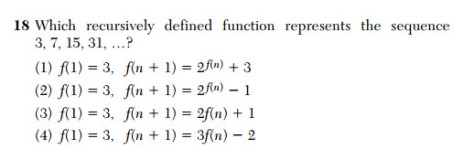
From the January 2016 Common Core Algebra I RegentsJan 2016 Alg I 18

According to www.regentsprep.org:
“Recursion is the process of choosing a starting term and repeatedly applying the same process to each term to arrive at the following term.  Recursion requires that you know the value of the term immediately before the term you are trying to find.”

This question is all about notation.  Recursive means what happens to each number so that it becomes the next number in the sequence. 

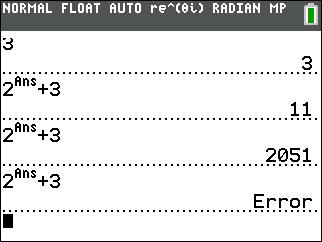
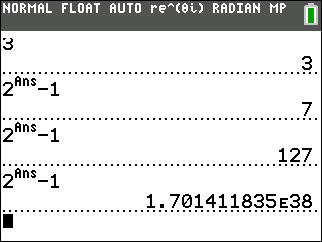
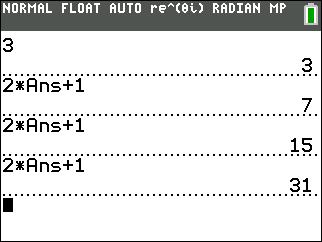
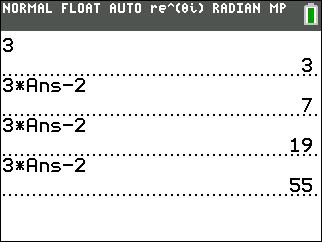
How can we get from 3 to 7 and then from 7 to 15?  and then from 15 to 31.  Each new number in pink is just a little bit more than double the previous number.  Look carefully at all four choices — only one of them is close to multiplying by 2.


f(1) = 3 means that the first number of the sequence is 3 which appears in all 4 answers.
f(n + 1) means the next number in the sequence.  


Jan 2016 Alg I 18aJan 2016 Alg I 18bJan 2016 Alg I 18cJan 2016 Alg I 18d

 Find the one that matches the given pattern :)

Get the Math and Get the Points Jan 2016 CC Alg I #17

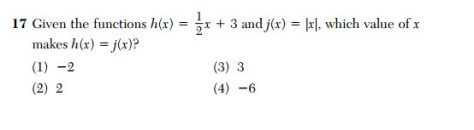
From the January 2016 Common Core Algebra I RegentsJan 2016 Alg I 17

Notice we are looking for the x value — similar to #1 on this very same Regents!!
https://mathconfidence.com/2016/05/02/get-the-math-and-get-the-points-notice-x/

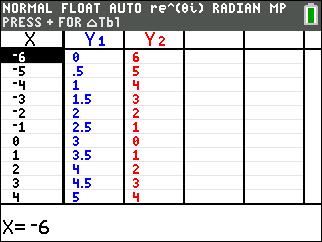
Input both equations into Y=…absolute value is found either under Math, Number or in the catalog which can be found by doing 2nd zero
For answer choice (1), when x = -2 both Y1 and Y2 are the same :)
For answer choice (2), when x = 2, Y1 = 4 while Y2 = 2
For answer choice (3), when x = 3, Y1 = 4.5 while Y2 = 3
For answer choice (4), when x = -6, here’s another snapshot with the table arrowed up to more negative numbers:
Jan 2016 Alg I 17d
when x = -6, Y1 = 0 while Y2 = 6.


Get the Math and Get the Points Jan 2016 CC Alg I #16

From the January 2016 Common Core Algebra I Regents
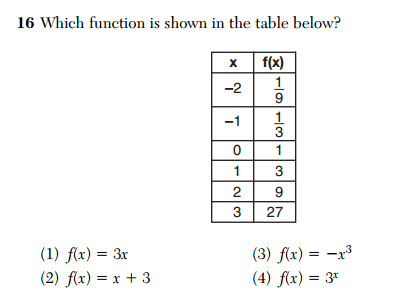
Jan 2016 A1 16

This is 2 points easily earned with a TI-84 while learning about the different types of
functions through comparing and contrasting. 
We need to check the xy table of each function and see if it matches the given table.

Below is answer (1) not a match.  By the way, check out the change in y — linear!!

Below is answer (2) also not a match.  Check out the change in y — linear!!


Onto answer choice (3) see below, um also not a match

And last but certainly not least, answer choice (4) see below: 2 points!!!!!

There are many extensions to this question!!

Linear vs exponential vs cubic in an equation and in a table
Use the TI-84 and also look at the equations to categorize the types of functions.

Two are linear as they look like y = mx + b and will graph in a line.
One of the functions is a power function and one is exponential.

Looking at rate of change of the xy table

Substituting in values of x into each equation to see if they make the equation true
The easiest x value to substitute is usually 0 so try it here and see if the y or f(x) value = 1 as shown in the table