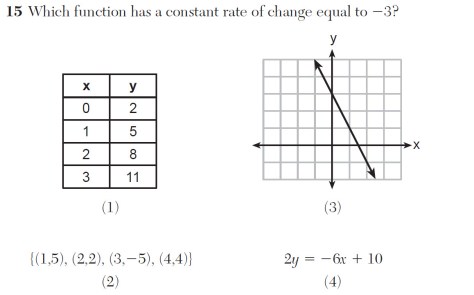
Another way to say constant rate of change is slope of a linear line.
Notice that in answer (1), while x is getting bigger, so is y — this is a positive slope of 3, and definitely does not match with the -3 we are looking for.
If you graph answer 2, it’s all over the place and doesn’t even have a constant rate of change.
Looking at the graph in answer 3, we can either use rise over run or the slope formula
m = (y2-y1)/(x2-x1) using two points on the graph (0,3) and (1,1). We can also say “When x goes up by 1, how much does y change?” and here we can see the slope is -2.
For answer 4, we would divide both sides by 2 to get a y= mx + b which would be y = -3x + 5 and here we can see the slope (m) would be -3.
Category Archives: test prep
Get the Math and Points June 2016 Alg I #22


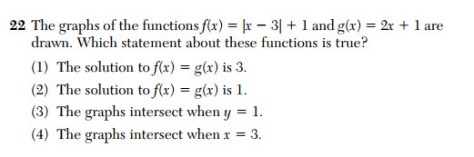
For more detail, below please find the table and the graph regraph with zoom 5 zoom square) which makes the tickmarks fair:


Looking at the graph and the table, we can see the point of intersection is (1,3)…now we have to read the answer carefully. Notice that answers 3 and 4 are backwards. And that answers 1 and 2 are the x value that makes the equation true. Match up the x value with the x value in the point (1,3) and voila — 2 more points!
Ace Placement Tests and Study for the ACCUPLACER (Avoid Remedial Classes)
When are we ever gonna use Math? On placement tests!
First click on this to see what students need to know:
https://accuplacer.collegeboard.org/sites/default/files/accuplacer-sample-questions-for-students.pdf (ACCUPLACER placement test sample questions)
The link above should be required reading (& writing & arithmetic) for all middle and high school students, their teachers, principals and families.
If high schools can share this information and help students ace their placement tests, then students can ace their placement tests, avoid remedial classes and take actual college courses.
Up to 75% of students end up in remediation and more than half the courses offered are at the remedial level.
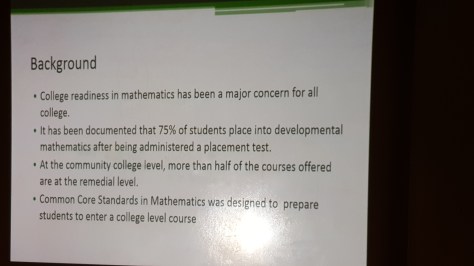
Credit:Prof Barbara Lawrence Borough of Manhattan Community College (CUNY)
Make sure you know what’s on the placement test and not just Math — Reading and Writing too! This is especially important for community college students as placement tests are administered to all students and 75% are placed into remedial classes aka developmental mathmatics..
CUNY (City University of New York) just switched to the ACCUPLACER placement tests from COMPASS which is being discontinued. Here is a link to an app for practice on this content:
https://accuplacerpractice.collegeboard.org/login
Create an account and practice!!
Get the Math and Points: Aug 2016 CC Alg I Regents #14
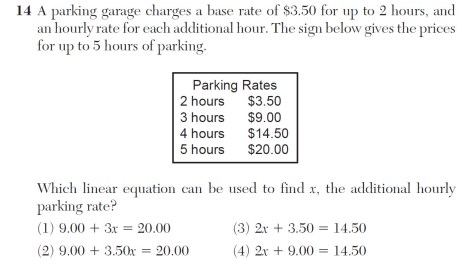
Notice how much it is for each additional hour:
$5.50. (9.00 – 3.50, 14.50 – 9.00, 20.00 – 14.50)
Let’s substitute in 5.50 into each equation and see if it makes the equation true.
(1) 9.00 + 3(5.50) = 20.00 that one is NOT true because 9 + 16.50 = 25.50 does NOT = 20
(2) 9.00 + 3.50(5.50) = 20 also not true
(3) 2 (5.50) + 9 = 11 + 9 = 20 :)
(4) 2 (5.50) + 9 does not equal 14.50.
That’s it — 2 more points!
(albeit very cheap parking rates)
Get the Math and Points: June 2016 CC Alg I Regents #21
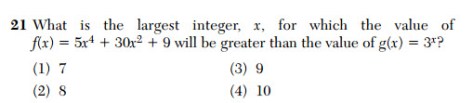
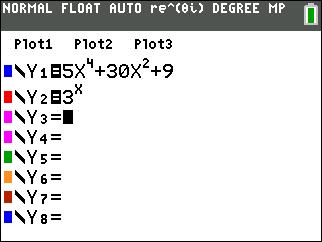
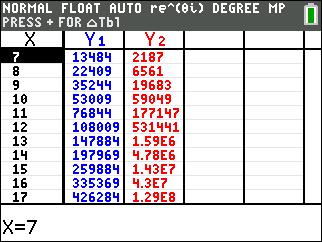
Putting both equations into Y= and studying the table can help us solve this one!!
Now we must read carefully! What is the largest integer for which f(x)>g(x)?
For x = 7, f(x) = 13484 and is greater than g(x) = 2187
For x = 8, f(x) = 22409 and is still greater than g(x) = 6561
For x = 9, f(x) = 35244 and is still greater than g(x) = 19683
For x = 10, f(x) = 53009 and is NO LONGER greater than g(x) = 59049
 Math Confidence by Robin the Math Lady