All posts by mathconfidence

Learn, Pass Regents, Graduate!!! Jan 16 Alg I #25

How to help your students pass the Regents, your son or daughter, niece or nephew, or yourself.
This is a series to help students pass the Regents and graduate high school while learning some Math in the process
For most students, the Math Regents they will focus on is Common Core Algebra I but we will also discuss Common Core Geometry.

Ready for Learn, Pass Graduate??
Let’s go!!

The Common Core exams are much harder than the old ones and students will need
1. more practice
2. more content knowledge
3. more content exposure
4. more motivation

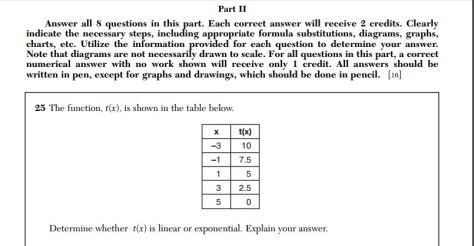
Are you ready?  See  below for the first installment: January 2016 long answer #25:
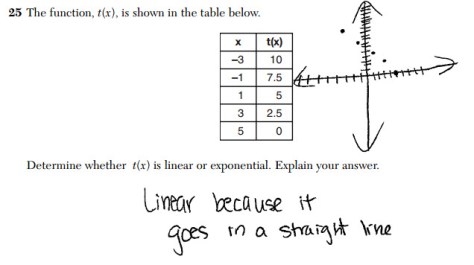
Jan 2016 Alg I Regents 25
This is an easy problem!!
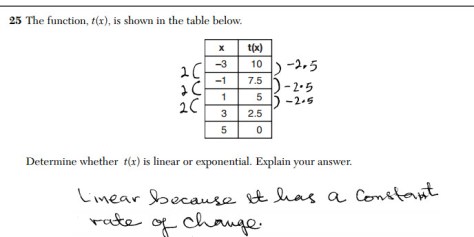
Students should be able to see that for every increase of 2 in x the y value is going down by 2.5 and therefore the function is linear
Here is a model response from the model response set from http://www.nysedregents.org/algebraone/116/algone12016-mrs.pdf
Jan 2016 Alg I Graphing Model Response Set 1

Another easy way is to draw it (again from the Model Response Set)
Jan 2016 Alg I Graphing Model Response Set 2

This is worth 2 points folks and it’s an easy 2 points so make sure you review.
It is also not exponential because it does not have a pattern like an exponential — here is an example of an exponential pattern of y = 2^x: 1, 2,4, 8, 16  each number in the sequence is double the number before.  The pattern has a constant multiplier, while our list of 10, 7.5, 5, 2.5, 0 has a constant rate of change of -2.5 which means it is a linear function or a line!!


Contest: Interpret Math Myth Cover by Weds 3/9 3PM EST

July 2012: The New York Times Sunday Review: the artwork below and  the headline “Is Algebra Necessary?”.  I was so stunned I couldn’t even think of how to respond, let alone write a Letter to the Editor (FYI, I have had 4 Letters published and many unpublished — this is something I usually love to do!).    It took me a week and a half to think of a clever retort and by then it was too late to send a letter so here goes — let’s see if y’all see it :)

Hint :”What are the people in the cover drawing below doing?” (looking for a particular perspective)
Please comment or send a tweet by Weds 3/9 3PM .
Winner(s) will get a folder of their choice from http://www.jetpens.com/Folders/ct/2008

math_myth_final

February 2016 Brain Teaser Solution

Some people think January 1, 2000 was the first day of the 21st century. Others think it was January 1, 2001. But everyone should agree that January 1, 2002 was the first “sum-day” of the new century- when you write out the date in numbers, 01/01/02, and 1+1=2. A sum-day is a date in which the day and month add up to the last two digits of the year. With that in mind:
A) What is the last sum-day of the 21st century?
B) How many sum-days are there in the 21st century?
Answers:
A) The last sum day is 12/31/43 or December 31, 2043
B) 365 as every day in a standard (non-leap) year is part of a sum-day for some year.
For example, November 24 is a sum-day for the year 2035, because 11+24=35. But the leap day doesn’t work because February 29, 2+29=31, but 2031 will not be a leap year.