All posts by mathconfidence

Get the Math and the Points! Jan 2016 CC Alg I #20

Jan 2016 Alg I 20
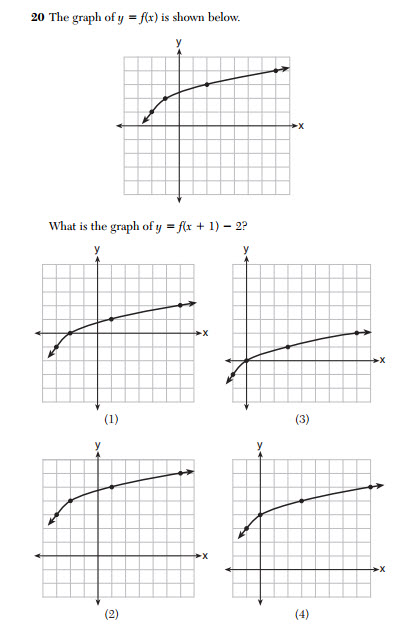
This is a transformation both horizontal and vertical translation or moving!
The – 2 moves down the entire graph by 2 as it is faithful and does what we think it will do
Only answers (1) and (3) have been moved down
But the (x + 1) part is the horizontal shift and does the opposite of what it looks like so it will shift left
The easiest way to do this is to pick a point on the original graph like (2,3)
Move it one unit left and two units down to (1,1)
Which of the two graphs for answers (1) and (3) go through (1,1)?


Easy Medium Hard Regents Questions

From the Jan 2016 Common Core Algebra I Regents:

The level of challenge on the Regents like any exam varies quite a bit.
After posting about #1-19 of the Jan 2016 Common Core Algebra I Regents, challenge level is being added to each problem.
Please comment if you feel a problem is misclassified as I am only right about 80% of the time.  Most importantly, students need to know what they find easy medium hard (often abbreviated as EMH)

that was easyc

click on the word easy for blog posts for Jan 2016 1 3 4 5 8 9 12 15 16
click on the word medium for blog posts for Jan 2016 2 7 13 14 17 18 19
click on the word hard for blog posts for Jan 2016 6 10 11 20

Get the Math and Get the Points Jan 2016 CC Alg I #18

From the January 2016 Common Core Algebra I RegentsJan 2016 Alg I 18

According to www.regentsprep.org:
“Recursion is the process of choosing a starting term and repeatedly applying the same process to each term to arrive at the following term.  Recursion requires that you know the value of the term immediately before the term you are trying to find.”

This question is all about notation.  Recursive means what happens to each number so that it becomes the next number in the sequence. 

How can we get from 3 to 7 and then from 7 to 15?  and then from 15 to 31.  Each new number in pink is just a little bit more than double the previous number.  Look carefully at all four choices — only one of them is close to multiplying by 2.


f(1) = 3 means that the first number of the sequence is 3 which appears in all 4 answers.
f(n + 1) means the next number in the sequence.  


Jan 2016 Alg I 18aJan 2016 Alg I 18bJan 2016 Alg I 18cJan 2016 Alg I 18d

 Find the one that matches the given pattern :)

Get the Math and Get the Points Jan 2016 CC Alg I #17

From the January 2016 Common Core Algebra I RegentsJan 2016 Alg I 17

Notice we are looking for the x value — similar to #1 on this very same Regents!!
https://mathconfidence.com/2016/05/02/get-the-math-and-get-the-points-notice-x/

Input both equations into Y=…absolute value is found either under Math, Number or in the catalog which can be found by doing 2nd zero
For answer choice (1), when x = -2 both Y1 and Y2 are the same :)
For answer choice (2), when x = 2, Y1 = 4 while Y2 = 2
For answer choice (3), when x = 3, Y1 = 4.5 while Y2 = 3
For answer choice (4), when x = -6, here’s another snapshot with the table arrowed up to more negative numbers:
Jan 2016 Alg I 17d
when x = -6, Y1 = 0 while Y2 = 6.