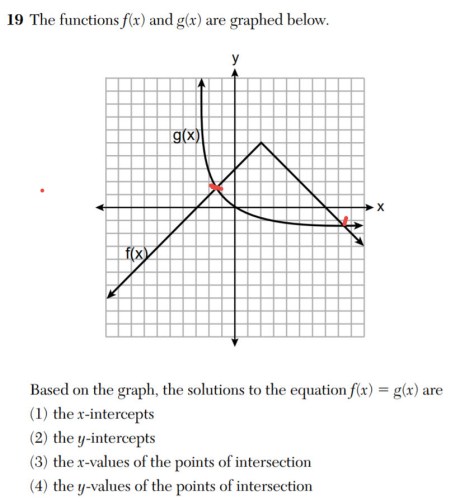
The two red marks are where f(x) = g(x), neither of which lie on the axes.
The x-intercepts would be on the x-axis and the y-intercepts would be on the y-axis.
The other clue is that solutions are x values.
The two red marks are where f(x) = g(x), neither of which lie on the axes.
The x-intercepts would be on the x-axis and the y-intercepts would be on the y-axis.
The other clue is that solutions are x values.
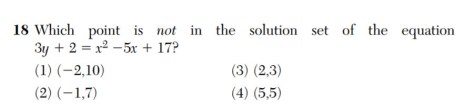
Try each point – we are looking for the one that does not work — that makes the equation untrue:
For x = -2 and y = 10: 3(10) + 2 = (-2)^2 – 5(-2) + 17
For x = -1 and y = 7: 3(7) + 2 = (-1)^2 – 5(-1) + 17
For x = 2 and y = 3: 3(3) + 2 = (2)^2 – 5(2) + 17
For x = 5 and y = 5: 3(5) + 2 = (5)^2 – 5(5) + 17
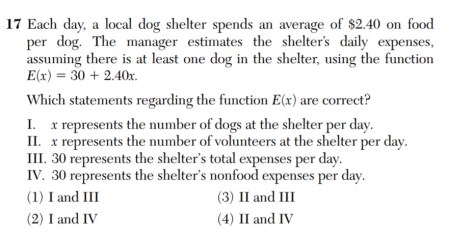
30 is the fixed cost and 2.40 is the variable cost (per dog)
so read really carefully

This is asking for factored form. We can take the factored form and double distribute aka FOIL to see if that algebra is equivalent to what was given.
Also, the original can be put into Y1 and each of the algebra in the answers can be put into Y2, then compare Y1 and Y2 to check your answer.
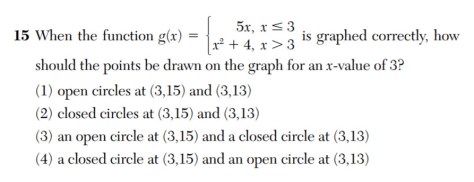
Above is a piecewise function which means part of the graph is linear (5x) and part of the graph is a parabola (x^2 + 4)>
A closed circle means it includes the value so a closed circle would be used for the top expression of 5x and an open circle would be used for x^2 + 4.
As x=3 is included in the top equation which is a closed circle when x = 3 and y = 15 (when we substitute x = 3 into 5x)
With x >3, it is an open circle at x =3…when we substitute x = 3 into x^2 + 4 we get 13.

