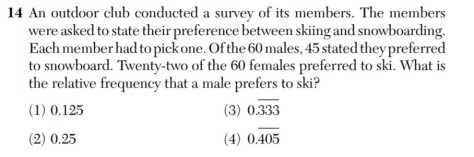
This relative frequency asks how many of the males prefer skiing.
How many males?
How many of them prefer skiing?
Create a fraction of these two numbers: (The number who prefer skiing)/(#of males)
This relative frequency asks how many of the males prefer skiing.
How many males?
How many of them prefer skiing?
Create a fraction of these two numbers: (The number who prefer skiing)/(#of males)

First add y and z
y = 3x^3 + x^2 – 5 and z = x^2 – 12
What like terms do you see? Combine them — be careful of the signed integers
Then double all the terms for 2(y + z)
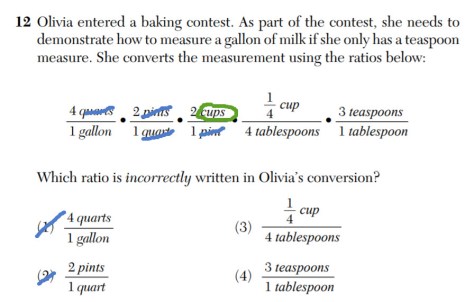
(sidenote: As a former engineer, I am not quite sure of the accuracy of Olivia’s measurement. )
This problem is a classic type of dimensional analysis exercise and two of the answers can be immediately eliminated.
Then try flipping (3) and then (4) and see which one cancels out tablespoons and cups resulting in teaspoons over gallons.
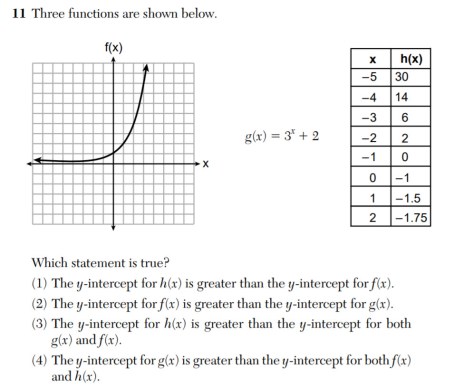
Whenever there is a y-intercept, x = 0
For f(x), where is the y-intercept? Look at the y-axis — where does it cross?
For g(x), substitute in x = 0, so g(0) = 3^0 + 2
For h(x), look at the table for when x = 0.
Then compare these y-intercepts with one another.
Which is the greatest?
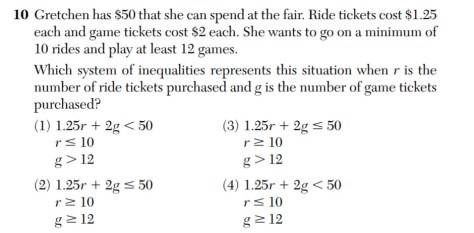 This is another close reading question (like #9)
The top inequality in each answer — should it include 50? or not?
Should r be more than 10 or less than 10?
Should g include 12 or not?

