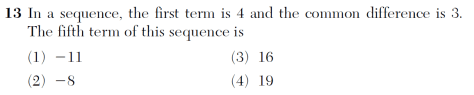
The first term is 4 : add 3 to find each successive term
so Term 2 = 7
Term 3 = 10 and so on
2 more points!!
The first term is 4 : add 3 to find each successive term
so Term 2 = 7
Term 3 = 10 and so on
2 more points!!
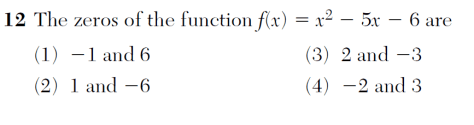 OMG this is 2 points for everyone!! A giveaway!! Get your TI-84 ready!!!!
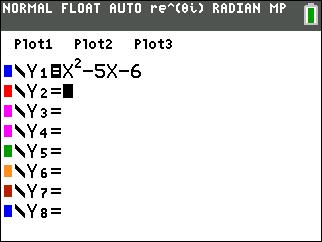
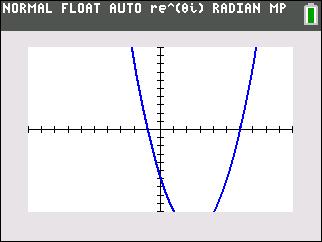
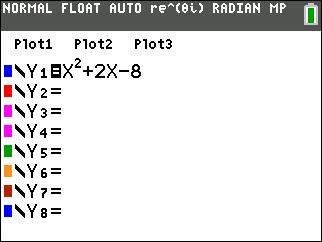
Put the equation into Y= and look for the zeros on the table and the graph.
For what x values is y = 0? Look at the table and the graph to verify your answer!!

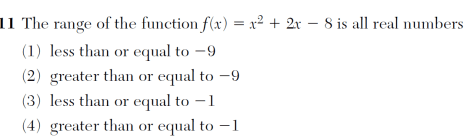
Which comes first in the alphabet, x or y? d or r?
Domain means the x values and Range means the y values
So we’re gonna graph this and check out the y values:
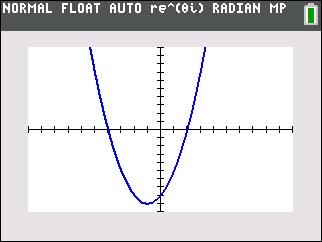
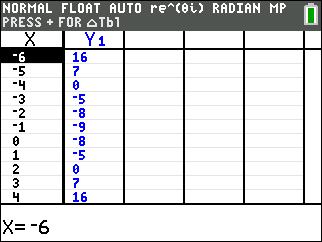 Looking at the graph, the lowest y value is less than -1. which can also be seen in the table above.
This gets rid of answers (3) and (4).
Are the y values greater or less than -9?
That’s it, 2 points.
Inspired by this tweet:

Looking at our latest Algebra I Regents, here in NY, here is a great example of the use of a graphing calculator and compare/contrast/use metacognition: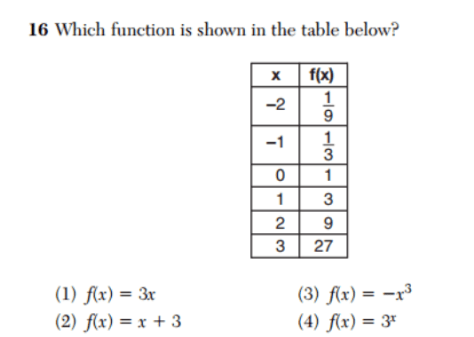
All 4 answer choices have a 3 but in different and important places!!
First question, does this xy table look like it is for a linear function?
We can look at the equations and see which f(x) = mx + b
We can also use the TI-84 and check the table to see if it matches the table above!
Let’s go to the graphing calculator:
Answer choice (1) below: this is linear and is clearly not a match especially since the rate of change is always 3 (every time x goes up by 1 y goes up by 3)


Answer choice (2) below is also linear as it has a constant rate of change…not a match:


Answer choice (3) is shown below and, well, we’re still lookin’:


2 points!!
These answers choices can be used to compare/contrast similarities and differences in their parent functions (linear, cubic and exponential).

First distribute the 5
3x + 2 ≤ 5x – 20 subtract 3x from both sides: 2 is on the left side and the right side is 2x -20
2 ≤ 2x – 20 now add 20 to both sides
22 ≤ 2x divide both sides by 2
11 ≤ x now match with the answer
 Math Confidence by Robin the Math Lady