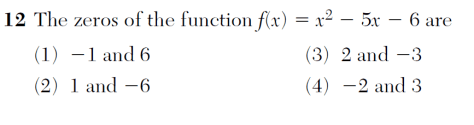
 OMG this is 2 points for everyone!! A giveaway!! Get your TI-84 ready!!!!
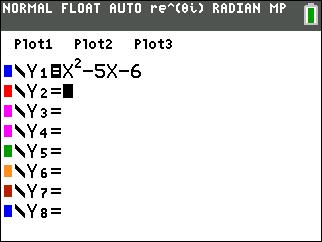
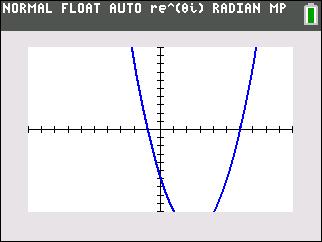
Put the equation into Y= and look for the zeros on the table and the graph.
For what x values is y = 0? Look at the table and the graph to verify your answer!!

All posts by mathconfidence
Get the Math and the Points: June 2016 CC Algebra I Regents #11
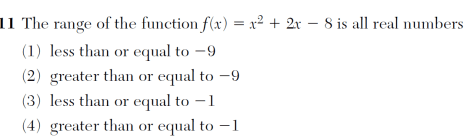
Which comes first in the alphabet, x or y? d or r?
Domain means the x values and Range means the y values
So we’re gonna graph this and check out the y values:
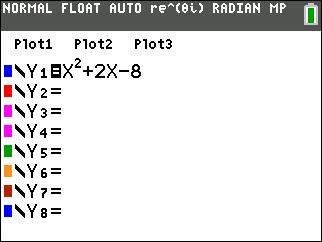
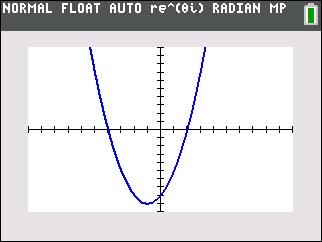
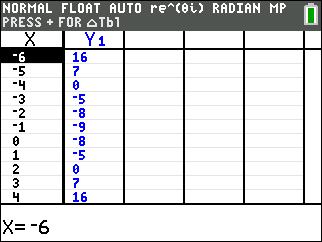 Looking at the graph, the lowest y value is less than -1. which can also be seen in the table above.
This gets rid of answers (3) and (4).
Are the y values greater or less than -9?
That’s it, 2 points.
Get the Math and Points: CC Algebra I June 2016 Regents #16 plus Metacognition
Inspired by this tweet:

Looking at our latest Algebra I Regents, here in NY, here is a great example of the use of a graphing calculator and compare/contrast/use metacognition: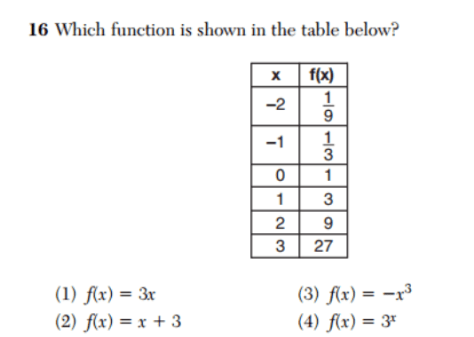
All 4 answer choices have a 3 but in different and important places!!
First question, does this xy table look like it is for a linear function?
We can look at the equations and see which f(x) = mx + b
We can also use the TI-84 and check the table to see if it matches the table above!
Let’s go to the graphing calculator:
Answer choice (1) below: this is linear and is clearly not a match especially since the rate of change is always 3 (every time x goes up by 1 y goes up by 3)


Answer choice (2) below is also linear as it has a constant rate of change…not a match:


Answer choice (3) is shown below and, well, we’re still lookin’:


Answer choice (4) is below!!


2 points!!
These answers choices can be used to compare/contrast similarities and differences in their parent functions (linear, cubic and exponential).
July 2016 Brain Teaser Solution
Q: In the town of Mathville, Anne is 5 years old.
The composition of the families in Mathville are as follows:
2% include five or more children
7% include four children
14% include three children
31% include two children
16% include one child
30% do not include any children
What are the chances that Anne lives with two brothers and no sisters?
(Consider all children living in any given house as siblings)
A: about 6.6%
First we have to assume that there is a 50-50 chance for each child’s gender (although studies have shown if you already have 2 boys, you are likelier to have another son rather than a daughter).
We also have to assume that 5 is the number of children of the very large families.
Since Anne is a child, she cannot possibly live in a household with no children.
So we need to think about this as a weighted average:
There is a (3×14)/(0 x 30 + 1 x 16 + 2 x 31 + 3 x 14 + 4 x 7 + 5 x 2) or 26.582% chance that she lives with two other children. Now we have to figure out the probability that both of the other children are boys.
There is a 50% chance that each of these other children is a boy, so there is a 25% chance that they are both boys (the combinations for the two other children are: BB, BG, GB and GG), Therefore, the probability that Anne lives with two brothers is 25% of 26.582%, or about 6.6%.
Get the Math and the Points June 2016 CC Alg I Regents #9

First distribute the 5
3x + 2 ≤ 5x – 20 subtract 3x from both sides: 2 is on the left side and the right side is 2x -20
2 ≤ 2x – 20 now add 20 to both sides
22 ≤ 2x divide both sides by 2
11 ≤ x now match with the answer

