All posts by mathconfidence

My May 2016 SAT Essay

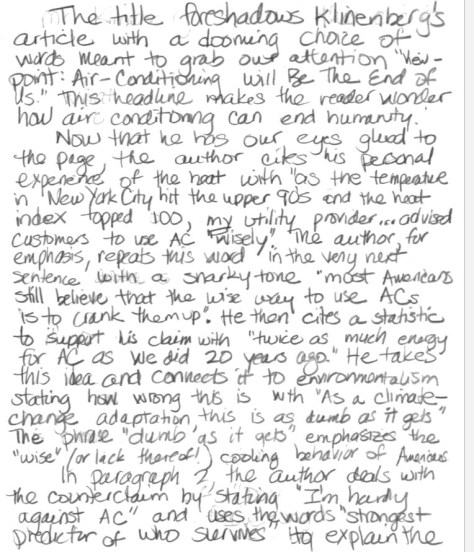
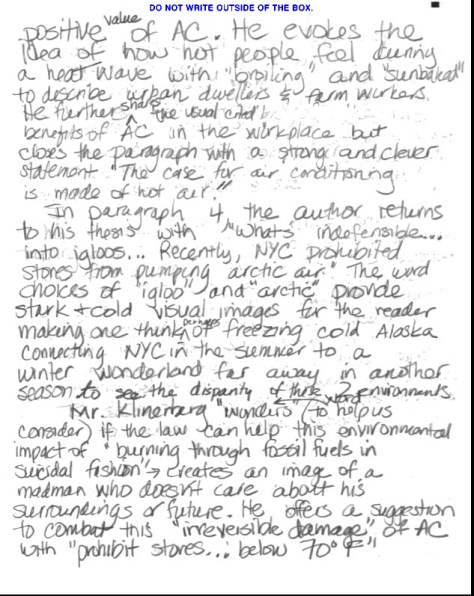
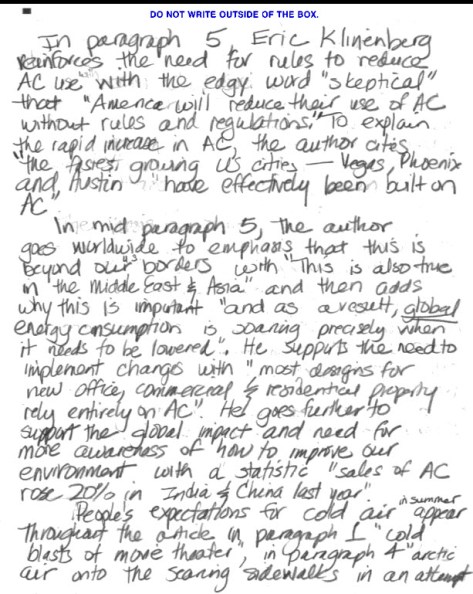
RAS May 2016 Essay page 1RAS May 2016 Essay page 2RAS May 2016 Essay Page 3


Here was the prompt:

As you read the passage below, consider how Eric Klinenberg uses

  • evidence, such as facts or examples, to support claims.
  • reasoning to develop ideas and to connect claims and evidence.
  • stylistic or persuasive elements, such as word choice or appeals to emotion, to add power to the ideas expressed.

Adapted from Eric Klinenberg, “Viewpoint: Air-Conditioning Will Be the End of Us.” ©2013 by Time Inc. Originally published July 17, 2013.

1

Earlier this week, as the temperature in New York City hit the upper 90s and the heat index topped 100, my utility provider issued a heat alert and advised customers to use air-conditioning “wisely.” It was a nice, polite gesture but also an utterly ineffectual one. After all, despite our other green tendencies, most Americans still believe that the wise way to use air conditioners is to crank them up, cooling down every room in the house—or even better, relax in the cold blasts of a movie theater or shopping mall, where someone else pays the bills. Today Americans use twice as much energy for air-conditioning as we did 20 years ago, and more than the rest of the world’s nations combined. As a climate-change adaptation strategy, this is as dumb as it gets.

2

I’m hardly against air-conditioning. During heat waves, artificial cooling can save the lives of old, sick and frail people, and epidemiologists have shown that owning an AC unit is one of the strongest predictors of who survives during dangerously hot summer weeks. I’ve long advocated public-health programs that help truly vulnerable people, whether isolated elders in broiling urban apartments or farm workers who toil in sunbaked fields, by giving them easy access to air-conditioning.

3

I also recognize that air conditioners can enhance productivity in offices and make factories safer for workers who might otherwise wilt in searing temperatures. Used conservatively—say, to reduce indoor temperatures to the mid-70s in rooms that, because of shortsighted design, cannot be cooled by cross-ventilation from fans and windows—air conditioners may well generate enough benefits to balance the indisputable, irreversible damage they generate. But in most situations, the case for air-conditioning is made of hot air.

4

What’s indefensible is our habit of converting homes, offices and massive commercial outlets into igloos on summer days, regardless of how hot it is outdoors. Recently, New York City prohibited stores from pumping arctic air out onto the searing sidewalks in an attempt to lure customers while burning through fossil fuels in suicidal fashion. I can’t help but wonder whether cities like New York will ever prohibit stores from cooling their facilities below, say, 70°F. No doubt a law like that would raise even more objections than Mayor Michael Bloomberg’s attempt to ban big sodas, but it might well be necessary if we can’t turn down the dial on our own.

5

I’m skeptical that American businesses and consumers will reduce their use of air-conditioning without new rules and regulations, especially now that natural gas has helped bring down energy bills and the short-term costs of cranking the AC are relatively low. Part of the problem is that in recent decades, the fastest-growing U.S. cities—places like Las Vegas, Phoenix and Austin—have effectively been built on air-conditioning. (This is also true in the Middle East and Asia, and as a result, global energy consumption is soaring precisely when it needs to be lowered.) Throughout the country, most designs for new office, commercial and residential property rely entirely on AC, rather than on time-honored cooling technologies such as shading from trees and cross-ventilation from windows and fans. As a result, there is now an expectation that indoor air will be frigid on even the steamiest days everywhere from the Deep South to the Great West. What’s worse, this expectation is spreading to the nations where American culture carries influence; sales of air conditioners rose 20% in India and China last year.

6

Trying to engineer hot weather out of existence rather than adjust our culture of consumption for the age of climate change is one of our biggest environmental blind spots. If you can’t stand the heat, you should know that blasting the AC will ultimately make us all even hotter. Let’s put our air conditioners on ice before it’s too late.

Write an essay in which you explain how Eric Klinenberg builds an argument to persuade his audience that Americans need to greatly reduce their reliance on air-conditioning. In your essay, analyze how Klinenberg uses one or more of the features listed in the box above (or features of your own choice) to strengthen the logic and persuasiveness of his argument. Be sure that your analysis focuses on the most relevant features of the passage.

Your essay should not explain whether you agree with Klinenberg’s claims, but rather explain how Klinenberg builds an argument to persuade his audience.

May 2017 Brain Puzzler Solution

Q: How many three-digit numbers satisfy the property that the middle digit is the average of the first and the last digits?

A: 45

With 1 as a middle digit, there are two three digit numbers whose middle digit is the average of the first and last digits:  111 and 210

There are 4 numbers with 2 as a middle digit: 123, 220, 321, 420
There are 6 numbers with 3 as a middle digit: 135, 234, 333, 432, 531, 630
There are 8 numbers with 4 as a middle digit: 147, 246, 345, 444, 543, 642 741, 840
There are 9 numbers with 5 as a middle digit: 159, 258, 357, 456, 555, 654, 753 852, 951
There are 7 numbers with 6 as a middle digit: 369, 468, 567, 666, 765, 864, 963
There are 5 numbers with 7 as a middle digit: 579, 678, 777, 876, 975
There are 3 numbers with 8 as a middle digit: 789 888, 987
There is 1 number with 9 as a middle digit: 999

Total: 2 + 4 + 6 + 8 + 9 + 7 + 5 + 3 + 1 = 45

Another way to solve this problem is to note that the middle digit is half the sum of the first and third digit so the sum must be even to result in a whole number when divided by 2.  To get two numbers to add to an even number they must be both odd or both even. Notice this in the list of 3 digit numbers above!

If both the first digit and the last digit are odd, then 1, 3, 5, 7, or 9 are choices for each of these digits, and there are $5\cdot5=25$ numbers in this case.
If both the first and last digits are even, then 2, 4, 6, 8 are choices for the first digit and 0, 2, 4, 6, 8 for the third digit. There are $4\cdot5=20$ numbers here.  25 + 20 = 45


April and May 2017 Brain Puzzler Solution

Link to the May 2017 Brain Puzzler Solution:
April’s Brain Puzzler
What is the area of the shaded region of the given 8 x 5 rectangle?

[asy]  size(6cm); defaultpen(fontsize(9pt)); draw((0,0)--(8,0)--(8,5)--(0,5)--cycle); filldraw((7,0)--(8,0)--(8,1)--(0,4)--(0,5)--(1,5)--cycle,gray(0.8));  label("$1$",(1/2,5),dir(90)); label("$7$",(9/2,5),dir(90));  label("$1$",(8,1/2),dir(0)); label("$4$",(8,3),dir(0));  label("$1$",(15/2,0),dir(270)); label("$7$",(7/2,0),dir(270));  label("$1$",(0,9/2),dir(180)); label("$4$",(0,2),dir(180));  [/asy]


The area is 6.5 square units.  
Using extra lines to break the shape into triangles is a great way to solve this problem.

https://artofproblemsolving.com/wiki/index.php/2016_AMC_10A_Problems/Problem_11

March 2017 Brain Puzzler Solution

Victoria refuses to sit next to either William or Xavier. Yasmin refuses to sit next to Zack. How many ways are there for the five of them to sit in a row of 5 chairs under these conditions?

Let Victoria be V, William be W, Xavier be X, Yasmin be Y and Zack be Z.   
Scenario 1: V sits on an end seat.

Then, since W and X can’t sit next to V, that must mean either Y or Z sits next to V.
After picking either Y or Z, then either W or X must sit next to Y/Z.
Then, the last two people can be arranged in two ways.
Since there are two different end seats that V can sit in, there are a total of .

 Scenario 2: V does not sit in an end  seat.

The are 3 seats for V to choose from
In this case, then only two people that can sit next to V are Y and Z, and they
can be in either order and there are two ways to arrange W and X
 
So the total is 28

Adapted from http://artofproblemsolving.com/wiki/index.php/2017_AMC_10A_Problems/Problem_19