All posts by mathconfidence

February 2018 Brain Puzzler Solution

Q: For a calendar, with two six sided dice make all possible monthly dates using two digits  (from 01 to 31) by writing one digit (from 0, 1, 2, …, 8, 9) on each face of the two dice.
A: It does not seem like it can be done — but…the Eureka part of the answer is:
the 9 is the 6 upside and vice versa!
Dice 1: 0 1 2 4 5 7 and  Dice 2: 0 1 2 3 8 9 (9 is also 6)
or
Dice 1 : 0 1 2 3 4 5 and Dice 2 : 0 1 2 6 7 8 (6 is also 9)

Get the Math and the Points Jan 2018 CC Alg I #2

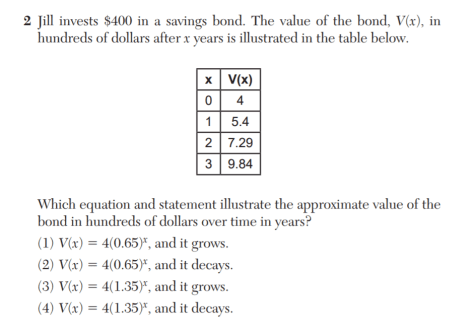
Jan 2018 CC Alg I 2
Two questions to ask:
1. Does V(x) grow or decay?
2. When putting 4(0.65)^x vs 4(1.35)^x into the Y= of the TI-83/4, does the table look like the one above?
Hopefully the student will know that the number in parentheses (the growth/decay factor) determines if it is growth or decay but through the graphing calculator, they can figure it out, get the right answer and earn 2 points!

January 2018 Brain Puzzler Solution

Q: What is the sum of the digits of the square of $111,111,111$?

A: 81
Using the standard multiplication algorithm, $111,111,111^2=12,345,678,987,654,321,$whose digit sum is 81.

Or by looking at the pattern:

$11^2 = 121 \\ 111^2 = 12321 \\ 1111^2 = 1234321$

$111,111,111^2=12,345,678,987,654,321$ whose digit sum is 81
There is a shortcut to adding these digits
Reading from left to right, we can add the first 8 digits, 1 through 8 by making 4 pairs of 9 (1 + 8, 2 + 7, 3 + 6 and 4 + 5) making 36
Reading from right to left, we can add the last 8 digits (1- 8) the same way making 36.
Leaving the middle digit of 9.

36 + 36 + 9 = 81

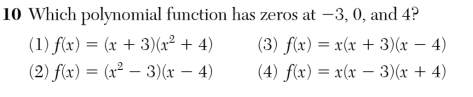
Get the Math and the Points! CC Alg I June 2017 Regents #10

June 2017 CC Alg I 10Can use the TI-83/4 to figure this one out!
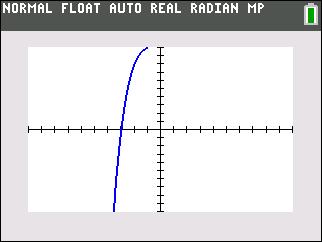
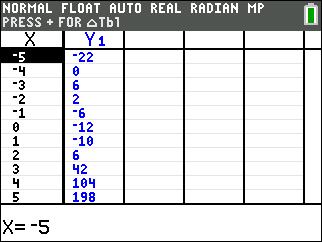
The zeros are the values of x that make f(x) or y equal to zero.

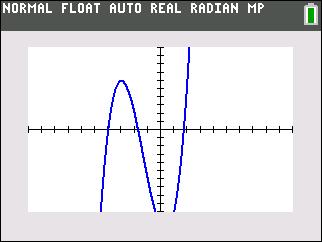
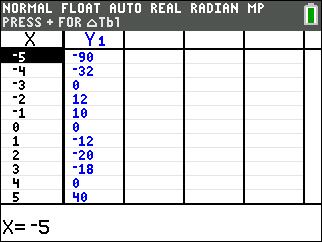
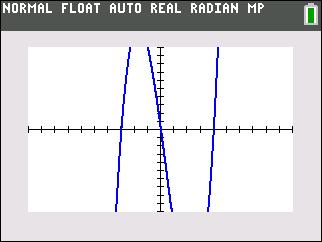
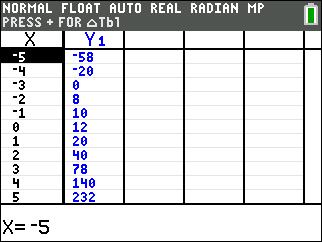
Answer (1) looks like this:  only 1 zero at x = -3 which can be seen on both the graph and the table
Aug 2017 CC Alg I 10a EqAug 2017 CC Alg I 10aAug 2017 CC Alg I 10a Graph

Answer (2) looks like this with 3 zeros but only one of them is an integer value (both the table and the graph show that (-4,0) is a point
Aug 2017 CC Alg I 10b yAug 2017 CC Alg I 10b tableAug 2017 CC Alg I 10b graph

Let’s try answer (3):

Aug 2017 CC Alg I 10c EqAug 2017 CC Alg I 10c tableAug 2017 CC Alg I 10c graph
Here we can see that on the table when x = -3 y = 0 and also when x = 0 and x = 4, y is also equal to zero.  Looking at the graph we can see that the 3 x-intercepts are integer values of -3, 0 and 4.  That’s it!

Pay close attention to the signs!! We need to look for the factors with the opposite sign to ‘zero it out’!  This can be a bit counterintuitive as when -3 is a solution then the factor is (x + 3), as -3 makes x + 3 = 0.  When 4 is a solution, the factor must be (x – 4)  rather than  (x+4) as plugging in 4 would not result in zero.


December 2017 Brain Puzzler Solution

Q: For the positive integers up to and including 2017, how many of those integers have at least one zero?

A:  There are $2017$ positive integers in total to consider.
No one digit numbers have a 0 (1-9).
Below is the list of the qualifying numbers:

There are 9 two digit numbers: 10,20, 30…90 9
There are the numbers 100 – 110 and 200-210 up to 900 – 910 99
Also 120 130 140…190 and then 220 230 etc 72
Then 1000-1099 100
Then same # of #s 1000 more than b 99
Then same # of #s 1000 more than c 72
2000-2017 18
 Total  469

Another solution is to exclude the numbers that do not have a zero and subtract from 2017:
9 one digit numbers
81 two digit numbers (9 x 9 : 9 choices for each digit 1-9)
729 three digit numbers (9 x 9 x 9: 9 choices for each digit 1-9)
For the numbers between 1000- 1999, there are the same amount as for the three digit numbers as they are the same numbers with a “1” in the thousands place value.
9 + 81 + 729 + 729 = 1548
2017 – 1548 = 469