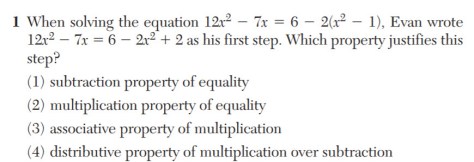
How did 6 – 2(x^2 – 1) become 6 – 2x^2 +2?
Help Evan identify this first step of his problem solving :)
That’s it! 2 points on the Regents!

How did 6 – 2(x^2 – 1) become 6 – 2x^2 +2?
Help Evan identify this first step of his problem solving :)
That’s it! 2 points on the Regents!


2 points :)
Q: Leaving at 8:00 AM, if Ms. Brown drives at an average speed of 40 miles per hour, she will be late by 3 minutes. If she drives at an average speed of 60 miles per hour, she will be early by 3 minutes. How many miles per hour does Ms. Brown need to drive to get to work exactly on time?
A: 48 miles per hour
There is a 6 minute difference between the fast (60 mph) speed and the slow (40 mph) speed. This 6 minutes is 1/10 of an hour.
Distance = rate x time. The two distances are equal so:
We can figure out how long it would take at 60 mph and go from there.
40 (t + .1) = 60 t
40t + 4 = 60 t
4 = 20 t
4/20 = t = 1/5 hour
So it will take 1/5 hour at 60 mph which is 12 miles. (1/5 hour = 12 minutes)
It will take abit longer at 40 mph:
1/5 hour + 1/10 hour =
.2 hour + .1 hour = .3 hour at 40 mph which is also 12 miles. (.3 hour is 18 minutes).
If Ms. Brown was exactly on time it would take her 15 minutes to go the 12 miles.
12 miles in 15 min = 48 mph.
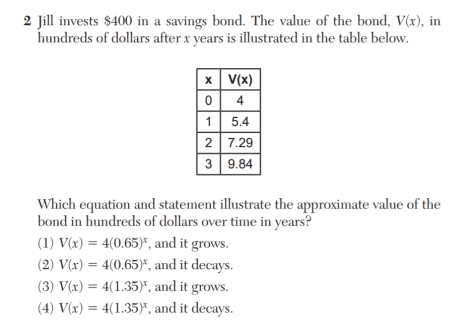
Two questions to ask:
1. Does V(x) grow or decay?
2. When putting 4(0.65)^x vs 4(1.35)^x into the Y= of the TI-83/4, does the table look like the one above?
Hopefully the student will know that the number in parentheses (the growth/decay factor) determines if it is growth or decay but through the graphing calculator, they can figure it out, get the right answer and earn 2 points!

