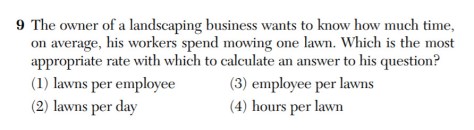
How much time will the workers spend? Think about the units :)
All posts by mathconfidence
August 2019 CC Alg I Regents #8
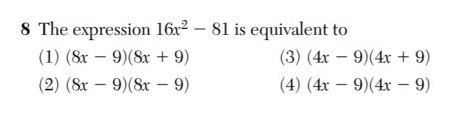
The first question is what are the signs: 2 pluses, 2 minuses or one of each which leaves just two answers.
The second question is how do we get 16x^2: is it (8x)(8x) or (4x)(4x)?
Get the Math and the Points! Compare/Contrast with the TI-84 Aug 19 #5
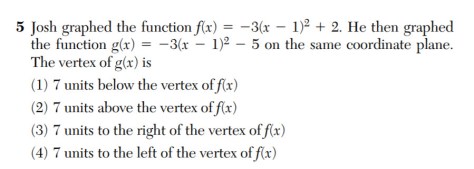
Using the Y= on the TI-84, we can compare/contrast the graphs of these two functions. How does the red compare to the blue?


Get the Math and the Points CC Alg I Regents Aug 2019 #6
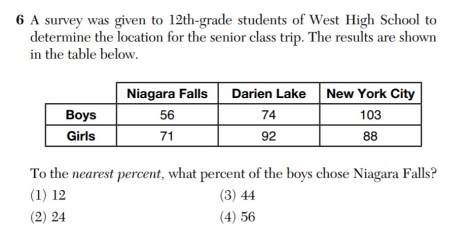
There are well over 200 boys altogether and only 56 chose Niagara Falls — way less than half so 2 of the answers can be eliminated.
How many boys chose Niagara Falls?
What was the total number of boys?
Use division:
56 out of the total number of boys
Get the Math & the Points CC Alg I Regents Aug 2019 #4
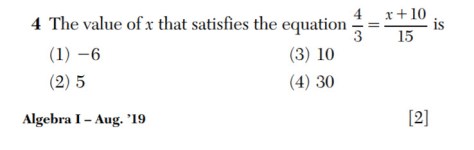
This question can be done in many ways. Students can cross multiply or find a common denominator or even try each of the four answers to find the one that when you add 10 to that number (x + 10) and then divide that by 15, the answer is 4/3.
That’s it — 2 points on the Regents!!

