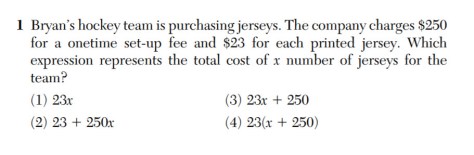
This is actually a reading question!
If x = 0, it will still cost 250
If x = 1, the cost should be 273 (250 + 23)
If x = 2, the cost should be 296 (250 + 23 + 23)
Try these values for x and you will find the answer :)
This is actually a reading question!
If x = 0, it will still cost 250
If x = 1, the cost should be 273 (250 + 23)
If x = 2, the cost should be 296 (250 + 23 + 23)
Try these values for x and you will find the answer :)

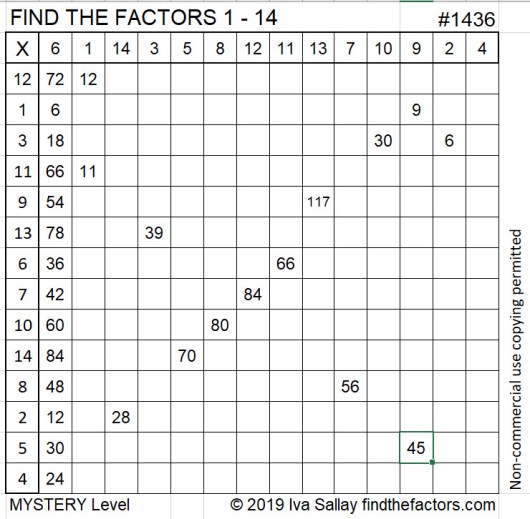
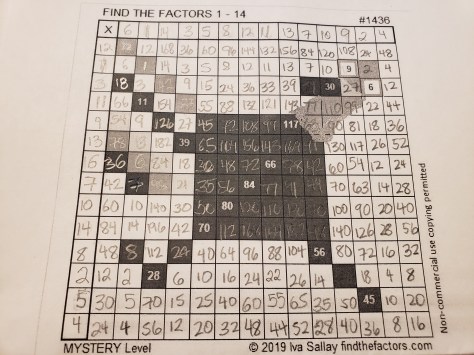
Of the many ways to measure a Math lesson, one is flow. The 75 minute blocks at my college can feel like a long time to be doing Math. Therefore, I try to have a variety of modalities within a lesson to capture students’ attention and to provide opportunities to learn and do Math.
The best flow experience I witnessed in my classroom was an activity (on Graphing Functions) starting at 1:58 which was 17 minutes before class ended. I had thought they would first work independently and then work in pairs.
1:58 handout given students have alone time to think and work while I visit deskside
2:05 students are working independently while I circulate around
2:10 students are still actively learning solo
2:15 class has officially ended — do I tell them?
2:20 they are STILL working — so engrossed
These students may have another class at 2:30 — our room is about to be taken over by the teacher and students waiting patiently outside the door.
2:23 Drat! I have to break the magic and tell them that class is over
At the end, I was delighted that students were totally in a flow state. They lost all sense of time while they were learning and doing Math. My only regret?
WHY DIDN’T I THINK TO HAND THIS OUT AT 1:45???

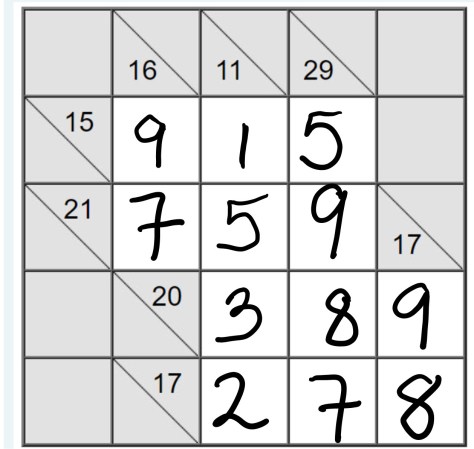
In Kakuro (also known as Cross Sums), no digits can be repeated in each sum. For example, 16 for two boxes must be 9 and 7 (or 7 and 9) and cannot be 8 and 8.
Q: How many factors of 155^9 are perfect squares and/or perfect cubes?
A: 37 factors of 155^9 are perfect squares and/or perfect cubes.
155 is a composite number composed of 5 x 31.
Therefore
155^9 = 5 x 5 x 5 x 5 x 5 x 5 x 5 x 5 x 5 x 31 x 31 x 31 x 31 x 31 x 31 x 31 x 31 x 31
25 Perfect Squares:
1: 1 is both a perfect square and a perfect cube.
4: Perfect squares with just 5s = 5^2, 5^4, 5^6, 5^8
4: Perfect squares with just 31s = 31^2, 31^4, 31^6, 31^8
Combining the 5s and the 31s Perfect Squares
4: 5^2 x 31^ 2, 5^4 x 31^2, 5^6 x 31^2, 5^8 x 31^2
4: 5^2 x 31^ 4, 5^4 x 31^4, 5^6 x 31^4, 5^8 x 31^4
4: 5^2 x 31^ 6, 5^4 x 31^6, 5^6 x 31^6, 5^8 x 31^6
4: 5^2 x 31^8, 5^4 x 31^8, 5^6 x 31^8, 5^8 x 31^8
12 Perfect Cubes:
Perfect cubes with just 5s = 5^3, 5^6 (already counted above), 5^9 (2)
Perfect cubes with just 31s = 31^3, 31^6 (already counted above), 31^9 (2)
Combining the 5s Perfect Cubes and the 31s Perfect Cubes
5^3 x 31^3, 5^6 x 31^3, 5^9 x 31^3 (3)
5^3 x 31^6, 5^9 x 31^6 (2)
5^3 x 31^9, 5^6 x 31^9, 5^9 x 31^9 (3)
 Math Confidence by Robin the Math Lady