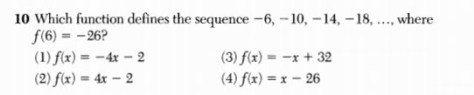
Each number in the sequence is 4 less than the number before so the rate of change is -4.
Putting that Y= – 4x – 2 into Y= gives this xy table where you can see the pattern and voila the 6th number is indeed -26!


Each number in the sequence is 4 less than the number before so the rate of change is -4.
Putting that Y= – 4x – 2 into Y= gives this xy table where you can see the pattern and voila the 6th number is indeed -26!
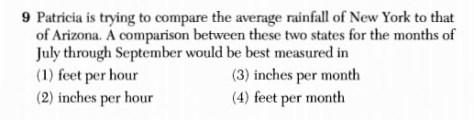 Um, this is a reading question. It asks about July to September so it must be in months. Do we measure rain in feet or inches? And how much rain does Arizona get anyway?
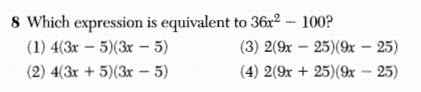
This is the difference of squares and must be factored with a + and – to get the -100. This eliminates answers (1) and (3)
Notice that answer (4) has 25 x 25 which would be way too much!
We can verify our answer by putting the info into the TI-84


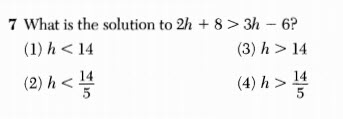
if we subtract 2h from both sides, we will get:
8 > h – 6
If we add 6 to both sides we will get
14 > h which can also be written as h<14 as we have to carefully match up that answer with either (1) or (3).
Let’s see if 0 will work as 14 > 0 would make the equation true.
2(0) + 8 > 3(0) – 6
8 > -6 this is true!!

The correlation coefficient tells us if the two data sets “Overall Student Average” and “Math Class Average” are related. Let’s put the data in order:
Overall Student Average 75 80 82 84 92 98
Math Class Average 75 85 78 85 91 95
Look at the trend:
The student with the lowest Overall Average has the lowest Math Class Average (75,75) and the highest Overall Average has the highest Math Class Average (98,95).
Looks like strong positive correlation as x gets bigger y is getting bigger which leads us to answer (2).
Here are some related links:
http://mathbitsnotebook.com/Algebra1/StatisticsReg/ST2CorrelationCoefficients.html
http://www.corestandards.org/Math/Content/8/SP/
https://www.khanacademy.org/math/probability/scatterplots-a1/creating-interpreting-scatterplots/e/correlation-coefficient-intuition
 Math Confidence by Robin the Math Lady