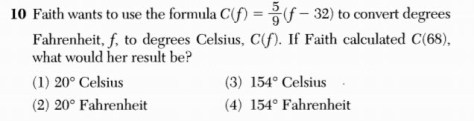
The answer would be in Celsius so only answers (1) and (3) are possible. Now plug in or substitute 68 into the equation: 5/9(68-32) = 5/9(36) = 20
So 68 F = 20 C That’s it — 2 points!!!
The answer would be in Celsius so only answers (1) and (3) are possible. Now plug in or substitute 68 into the equation: 5/9(68-32) = 5/9(36) = 20
So 68 F = 20 C That’s it — 2 points!!!
Q: How can one get the answer 24 by only using the numbers 8,8,3,3? (Using only + or – or x or division)
Here is the link to other solutions that include the usage of “!” also known as factorial
http://solution-dailybrainteaser.blogspot.com/2011/12/maths-puzzle.html
or…how low can you go?
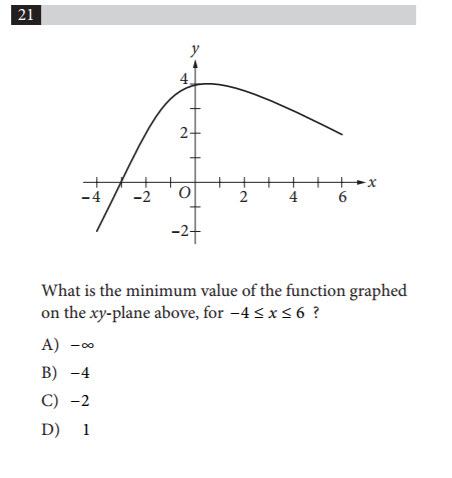
What is the lowest y value on this graph? That’s all they wanna know!
The lowest point is at (-4, -2). Choose that y value!!!
PS for this question no graphing calculator or any calculator needed
This problem ( opportunity) is really about attention to detail.
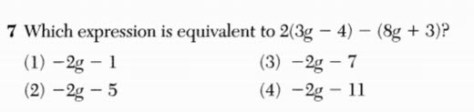
Mathematically, we need to use the distributive property.
2 (3g -4) = 6g -8
-(8g + 3) = -8g -3
Put em together: 6g – 8g definitely-2g. Look at all the answers: they all have-2g
Put em together: -8 – 3. Here’s the decision point
-8 less 3 or you lose $8, you lose $3, or you can use a number line!
That’s awesome…2 more points!!
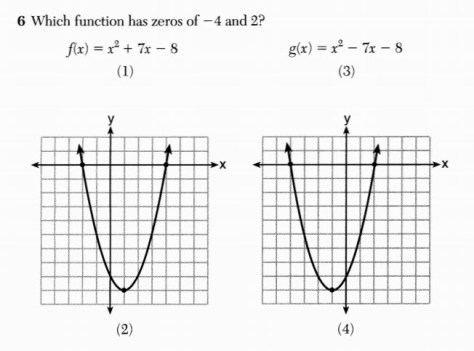
We can already analyze the two graphs above for the zeros.
Notice how (2) crosses the x-axis at (-2,0) and (4,0) at the ‘dots’ on the x-axis so that’s not right as we are looking for zeros of -4 and 2 (close but opposite signs)>
Ok let’s check out (4)…
Notice how (4) crosses the x-axis at (-4,0) and (2,0)? :)
(If we had to check (1) and (3), we would put each equation into Y= and check out the graph and/or table but no need to do that this time around)

