Using the TI-84 makes this an easy question — we can see that the two functions — a linear and an absolute value intersect once at (2,4)…then we have to read clearly to see if the question is asking for x or y. Get the Math and get 2 more points!!


Using the TI-84 makes this an easy question — we can see that the two functions — a linear and an absolute value intersect once at (2,4)…then we have to read clearly to see if the question is asking for x or y. Get the Math and get 2 more points!!

Look at the difference between the Given and Step 1…
A great visual to compare the above to is:
 https://profteacher.com/2009/12/11/distributive-property/
https://www.khanacademy.org/math/algebra-basics/alg-basics-algebraic-expressions/alg-basics-distributive-property/e/distributive-property-with-variables
That’s it — two points!
Q: Write down all the integers from 1 through 60 to form the number
123456789101112131415161718…495051525354555657585960.
Now delete 100 digits from this number.
Without rearranging the digits, what is the largest number possible?
A: Writing down all integers from 1 through 60 gives you a number 111 digits long:
9 numbers at 1 digit apiece: 9 digits
51 numbers at 2 digits apiece: 102 digits
Total: 111 digits.
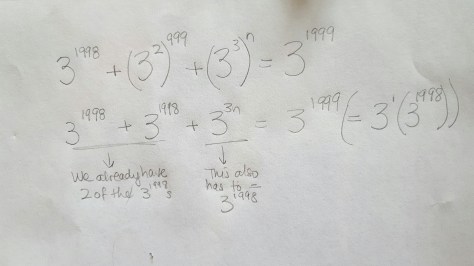
It takes 3 3^1998s to make 3^1999 as 3 x 3^1998 = 3^1999
Therefore 3^(3n) = 3^1998
so 3n = 1998 and n = 666