Category Archives: brain puzzler

October 2020 Brain puzzler solution

Q: FUN is a three digit number where F, U, N are single digits (not including 0).If FUN = F! + U! + N!, then what is the number FUN?
(where ! = factorial).

A: 145 = 1! + 4! + 5!

Because it is a three digit number, none of the digits can be more than 6 as 7! is 5040 and is therefore four digits. This means that we only need to try 1 2 3 4 5 and 6. But 6! is 720 and we only have 1 2 3 4 5 6 so now 6 is disqualified.
This leaves us with only 1 2 3 4 5.

5! is 120 (5 x 4 x 3 x 2 x 1)
4! is 24 (4 x 3 x 2 x 1)
3! is 6 (3 x 2 x 1)
2! is 2 (2 x 1) and
1! is 1

In order for the number to add up to three digits, 5! has to be one of the components. Our answer will definitely start with F=1 and therefore one of the other digits is 1.

Now we have two out of 3 digits, F = 1 and N = 5 and 1! + 5! = 121 (our subtotal)

Now we will try adding U! 2!, 3! and 4! to our subtotal.

1! + 2! + 5! = 1 + 2 + 120 = 123 not equal to FUN of 125
1! + 3! + 5! = 1 + 6 + 120 = 127 not equal to FUN of 135
1! + 4! +5! = 1 + 24 + 120 = 145 and is EQUAL to FUN of 145.

A shoutout to Colin Porteus who amended the solution for July’s Brain Puzzler — thanks for your sharp mind and eyes.
https://mathconfidence.com/2020/07/27/july-2020-brain-puzzler-solution/


September 2020 Brain Puzzler Solution

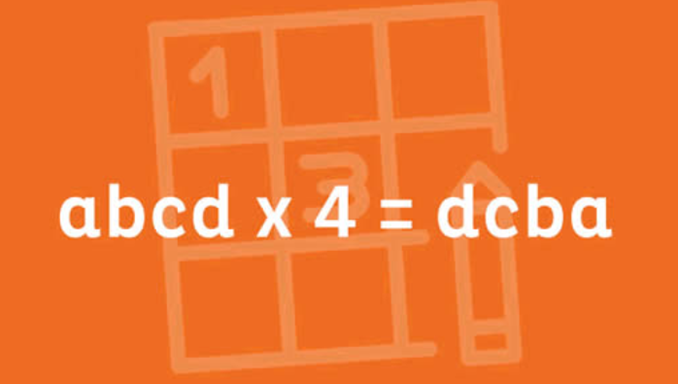
abcd image002

a has to be either 1 or 2 as multiplying by 4 keeps the number 4 digits.
(if a= 3 then quadrupling that number would be >12000 (5 digits)  )

if a was 1 then d would have to be 4 so our number abcd would be:
1bc4 and its reverse would be 4cb1 which cannot be as an integer multiplied by 4 has to be even.

Therefore a has to be 2.
Making d = 8.

When multiplying 2bc4 x 4  to be 8cb2, b and c cannot be too large as multiplying by 4 would then make the thousands place >8.

For example if b = 3 then even the lowest # in the 2300s,  2300 x 4 = 9200  would be too large as a = 9.

So b must be 0, 1 or 2
b cannot be 0 as 20cd x 4 = dc02 and multiples of 4 always with the last two digits as a multiple of 4.
b cannot = 2 since a is already 2 so b must = 1!

c cannot be 1, 2, or 8 as they have already been used

So abcd is now 21c8 x 4 = 8c12
If c = 0, 2108 x 4 does not end in 12
If c = 3, 2138 x 4 does not end in 12
If c = 4, 2148 x 4 does not end in 12
If c = 5, 2158 x 4 does not end in 12
If c = 6, 2168 x 4 does not end in 12
If c = 7, 2178 x 4 DOES end in 12
If c = 9, 2198 x 4 does not end in 12
c cannot be 1, 2, or 8 as they have already been used

2178 x 4 = 8712


August 2020 Brain Puzzler Solution

Question

If the probability of a false positive of a medical test (could be COVID-19) is 3%, what percent of people who test positive would actually have it?

Scenario 1: The disease is present in 1 person in 1000

Scenario 2: the disease is present in 1 person in 5


Answer

Scenario 1: 3.2% and Scenario 2: 89.3%

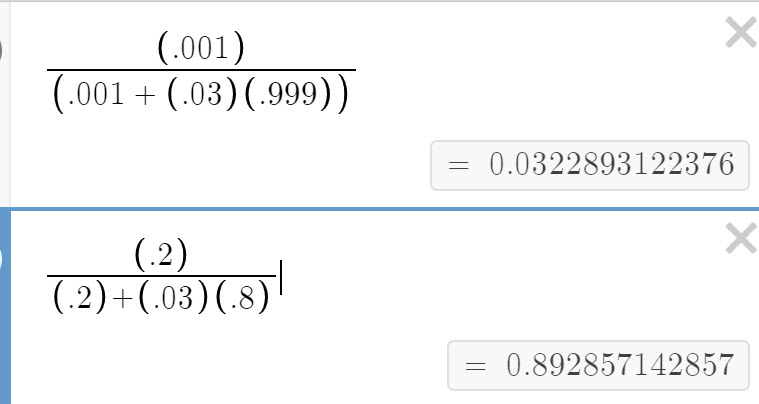
We need to compare the actual positives with the sum of the true positives and false positives.  In Scenario 1, if 1 in 1000 (.001) have it then 999 out of 1000 (.999) do not.

In Scenario 2, if 1 in 5 (.2) have it then 4 out of 5 (.8) do not.


Desmos False PositiveScenario 1:

comparing the true positives with the total positives  (true positive plus false positive)

approximately 3.2%.

Scenario 2:

comparing the true positives with the total positives (true positive plus false positive)

approximately 89%

July 2020 Brain Puzzler Solution

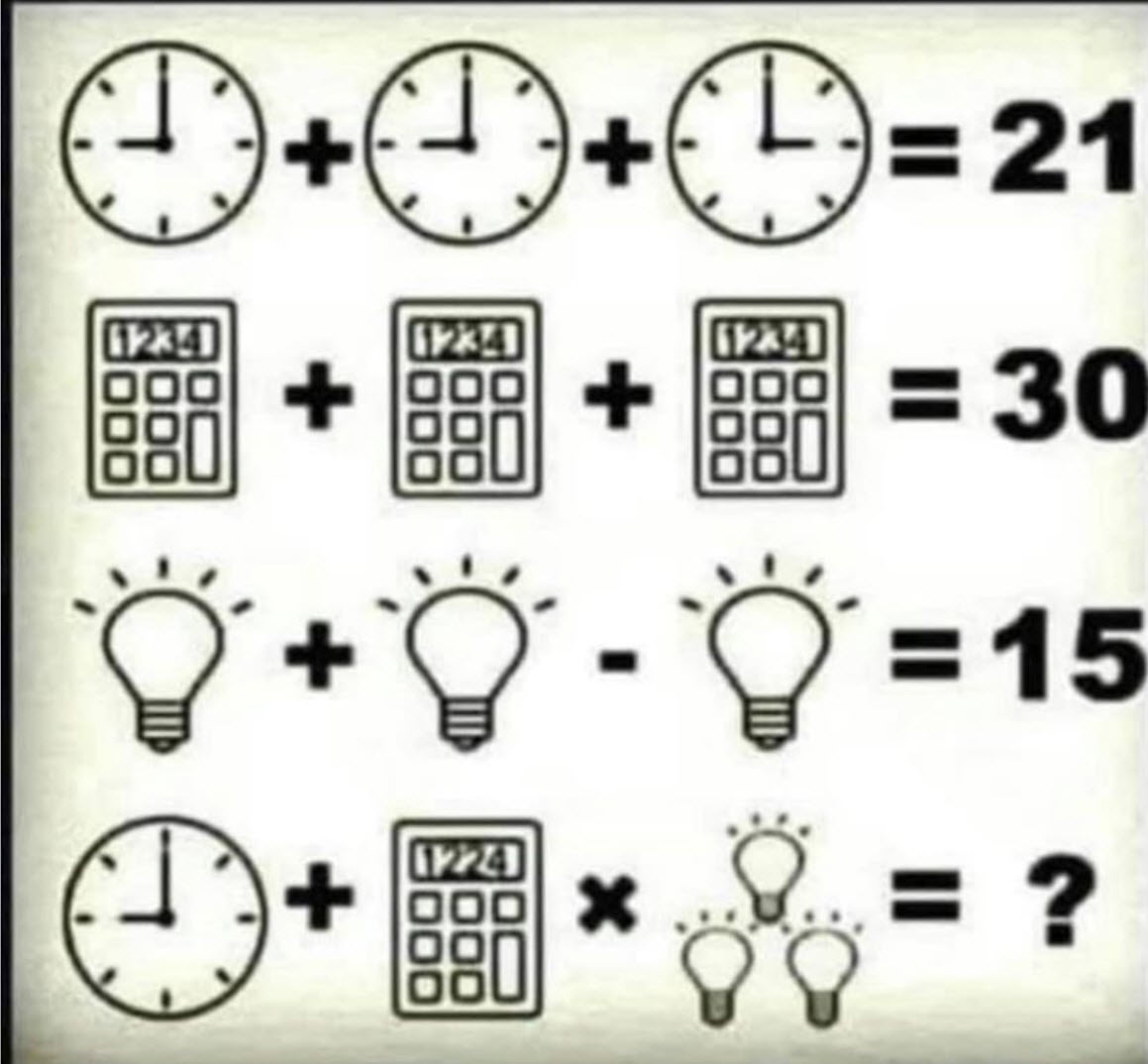
Brain Teaser from Ken M
A: 333

The clocks in the first row represent 9 + 9 + 3
The calculators in the second row are each 10 (also 1234 added together is 10)
Each lightbulb in the third row is 15 (15 + 15 – 15) = 15.
Which means each ray above the lightbulb =3
So in the last row:
9 + 9 x (12 + 12 + 12)
9 + 9(36)
9 + 324
333

10/31/20 update from Colin Porteus — thanks for your sharp eyes!!

Hello Robin, can you check the last row on this one please? I get 9 + 9 x (12 + 16+ 16)?? The bottom two globes have 4 threads each x the 4 light marks makes them 16 each?? So consequently I get a result of 405.
Thank you

June 2020 Brain Puzzler Solution

Q: What is the median of the following list of numbers: (There are 4040 numbers)

1, 2, 3…2020, 1^2, 2^2, 3^2…2020^2?

A: 1976.5

In order to put these into order from least to greatest, we have to figure out how many of the square(d) numbers are less than 2020:

 1^2 (1) – 10^2 (100) is 10 numbers
11^2 (121) – 20^2 (400) is 10 numbers
      21^2 (441) – 30^2 (900) is 10 numbers
        31^2 (961) – 40^2 (1600) is 10 numbers
        41^2 (1681) – 44^2 (1936) is 4 numbers

There are 4040 numbers altogether so we need to know the 2020th and 2021st numbers and get the mean of those two numbers to find the median.
Inserting the 44 perfect squares above into the first 2020 numbers would make 2020 the 2064th number so we need to subtract 43 and 44 from 2020 to find those two numbers (the 2020th and 2021st).
By the way, the nearest perfect square under 2020 is 1936 which (luckily!) is too far away for us to think about!

2020 – 43 = 1977 and 2020 – 44 = 1976

Therefore the median of the list of numbers above is 1976.5.