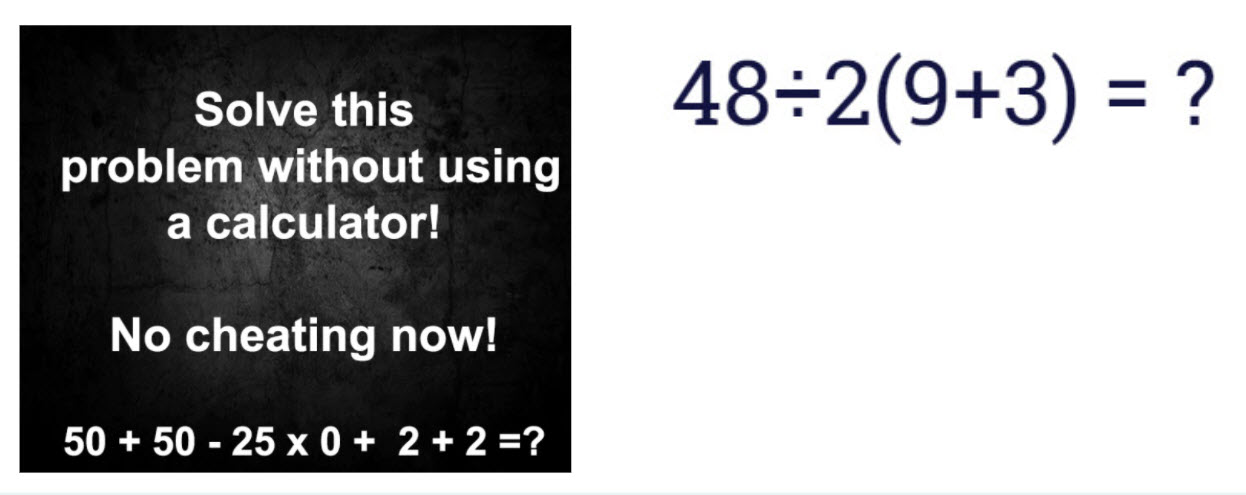
The puzzles above are all about Order of Operations:
50 + 50 – 25 x 0 + 2 + 2
50 + 50 – 0 + 2 + 2
104
48 divided by 2(9 + 3)
48 divided by 2 x 12
Now go from left to right
24 x 12
288
The puzzles above are all about Order of Operations:
50 + 50 – 25 x 0 + 2 + 2
50 + 50 – 0 + 2 + 2
104
48 divided by 2(9 + 3)
48 divided by 2 x 12
Now go from left to right
24 x 12
288
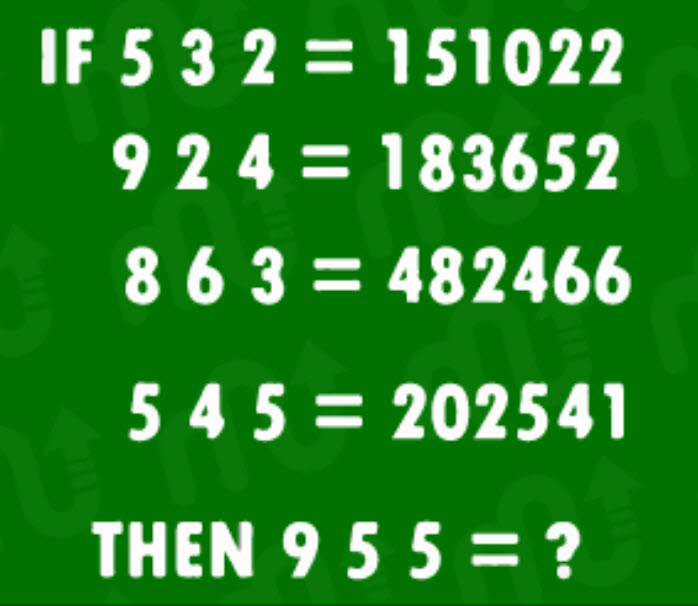
A: 454585
9 5 5 =?
9×5 = 45 (first and second)
9×5 = 45 (first and third)
Sum of 45+45 = 90 and from this deduct center number 5 = 85
Q: FUN is a three digit number where F, U, N are single digits (not including 0).If FUN = F! + U! + N!, then what is the number FUN?
(where ! = factorial).
A: 145 = 1! + 4! + 5!
Because it is a three digit number, none of the digits can be more than 6 as 7! is 5040 and is therefore four digits. This means that we only need to try 1 2 3 4 5 and 6. But 6! is 720 and we only have 1 2 3 4 5 6 so now 6 is disqualified.
This leaves us with only 1 2 3 4 5.
5! is 120 (5 x 4 x 3 x 2 x 1)
4! is 24 (4 x 3 x 2 x 1)
3! is 6 (3 x 2 x 1)
2! is 2 (2 x 1) and
1! is 1
In order for the number to add up to three digits, 5! has to be one of the components. Our answer will definitely start with F=1 and therefore one of the other digits is 1.
Now we have two out of 3 digits, F = 1 and N = 5 and 1! + 5! = 121 (our subtotal)
Now we will try adding U! 2!, 3! and 4! to our subtotal.
1! + 2! + 5! = 1 + 2 + 120 = 123 not equal to FUN of 125
1! + 3! + 5! = 1 + 6 + 120 = 127 not equal to FUN of 135
1! + 4! +5! = 1 + 24 + 120 = 145 and is EQUAL to FUN of 145.
A shoutout to Colin Porteus who amended the solution for July’s Brain Puzzler — thanks for your sharp mind and eyes.
https://mathconfidence.com/2020/07/27/july-2020-brain-puzzler-solution/
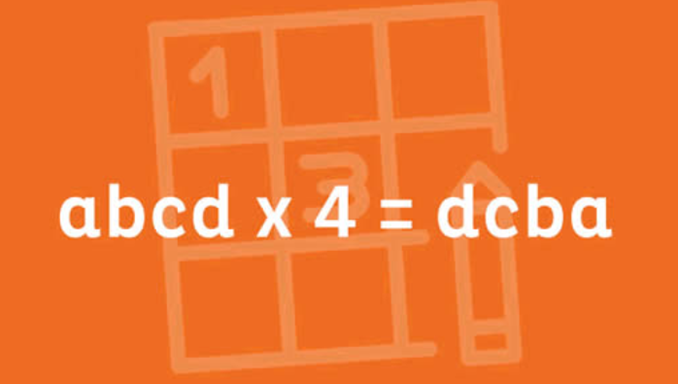
a has to be either 1 or 2 as multiplying by 4 keeps the number 4 digits.
(if a= 3 then quadrupling that number would be >12000 (5 digits) )
if a was 1 then d would have to be 4 so our number abcd would be:
1bc4 and its reverse would be 4cb1 which cannot be as an integer multiplied by 4 has to be even.
Therefore a has to be 2.
Making d = 8.
When multiplying 2bc4 x 4 to be 8cb2, b and c cannot be too large as multiplying by 4 would then make the thousands place >8.
For example if b = 3 then even the lowest # in the 2300s, 2300 x 4 = 9200 would be too large as a = 9.
So b must be 0, 1 or 2
b cannot be 0 as 20cd x 4 = dc02 and multiples of 4 always with the last two digits as a multiple of 4.
b cannot = 2 since a is already 2 so b must = 1!
c cannot be 1, 2, or 8 as they have already been used
So abcd is now 21c8 x 4 = 8c12
If c = 0, 2108 x 4 does not end in 12
If c = 3, 2138 x 4 does not end in 12
If c = 4, 2148 x 4 does not end in 12
If c = 5, 2158 x 4 does not end in 12
If c = 6, 2168 x 4 does not end in 12
If c = 7, 2178 x 4 DOES end in 12
If c = 9, 2198 x 4 does not end in 12
c cannot be 1, 2, or 8 as they have already been used
2178 x 4 = 8712
 Math Confidence by Robin the Math Lady